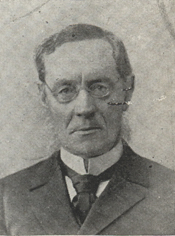
 William Everett (October 10, 1839 – February 16, 1910) was a distinguished American academic, classicist, Unitarian minister, and politician.
Queer Places:
Boston Latin School, 78 Avenue Louis Pasteur, Boston, MA 02115
Harvard University (Ivy League), 2 Kirkland St, Cambridge, MA 02138
University of Cambridge, 4 Mill Ln, Cambridge CB2 1RZ
Adams Academy (now Quincy Historical Society & Museum), 8 Adams St, Quincy, MA 02169, USA
Mount Auburn Cemetery, Cambridge, Middlesex County, Massachusetts, USA
William Everett (October 10, 1839 – February 16, 1910) was a distinguished American academic, classicist, Unitarian minister, and politician.
Born in Watertown, Massachusetts, he came from a prominent political family. He was the youngest of six children born to Charlotte Gray Brooks and Edward Everett, a towering figure of the 19th century who served as Governor of Massachusetts, U.S. Secretary of State, Minister to the United Kingdom, President of Harvard College, and orator who famously shared the platform with Abraham Lincoln at Gettysburg.
Everett's academic trajectory spanned elite institutions on both sides of the Atlantic. After attending the Boston Latin School—where he won the prestigious Franklin Medal—he entered Harvard College, graduating with high honors in 1859. He then crossed the ocean to study at Trinity College, Cambridge, navigating both the Mathematical and Classical Triposes and graduating with a BA in 1863, later receiving his MA. During his time at Cambridge, his intellectual prowess and social standing were cemented when he was elected as a member of the elite, secretive intellectual discussion society known as the Cambridge Apostles, making history as the first American ever elected to the group. He also served as President of the Cambridge Union Society in 1862.
Returning to the United States, Everett pursued further professional training, earning an LLB from Harvard Law School in 1865. Though he was admitted to the Boston bar in 1866, he never pursued active legal practice. Instead, his career gravitated toward academia, literature, and the pulpit. He returned to Harvard as a Latin tutor from 1870 to 1873 and was subsequently appointed as an Assistant Professor of Latin, serving until 1877. Expanding his scholarly credentials, he earned a PhD in Philology from Harvard in 1875. In 1872, he was licensed to preach by the Suffolk Association of Unitarian Ministers. Though never ordained as a settled pastor, he was a prolific hymn writer and a frequent, well-regarded speaker in New Unitarian pulpits across New England.
In 1878, Everett took on the role of headmaster (master) at the prestigious Adams Academy in Quincy, Massachusetts, a position he held with great distinction for over a decade. His tenure was defined by rigorous classical instruction until he stepped down in 1893 to enter federal politics. Running as a Democrat—having shifted away from his early alignment with the Republican Party over civil service and tariff reforms—he was elected to the Fifty-third United States Congress, representing Massachusetts's seventh district to fill the vacancy left by Henry Cabot Lodge. During his congressional term, he chaired the House Committee on Foreign Affairs. Declining a renomination, he returned to Quincy in 1895 to resume his headmastership at Adams Academy. Following in his father's footsteps, he ran for Governor of Massachusetts in 1897, though he ultimately lost the election to the incumbent Roger Wolcott. He remained at Adams Academy for the remainder of his life, deeply respected as one of the nation's leading Greek and Latin scholars, holding honorary degrees from institutions like Williams, Dartmouth, and Cambridge, and serving as a Fellow of the American Academy of Arts and Sciences.
Regarding LGBTQ links, there is no historical evidence or documentation indicating that William Everett identified as LGBTQ or engaged in same-sex romantic relationships. His life unfolded within the conventional social framework of 19th-century Victorian academia and elite American society. While his membership in the Cambridge Apostles places him within a network that in later decades became famously associated with queer intellectualism (such as the Bloomsbury Group figures of the early 20th century), during Everett's mid-Victorian era, the society functioned primarily as an elite, homosocial philosophical and debating club focused on rigorous moral, metaphysical, and literary discourse. Everett himself was famously critical of certain intellectual affectations of his peers, viewing some debates with characteristic academic severity.
William Everett died on February 16, 1910, at the age of 70 in Quincy, Massachusetts, following a long illness. He was laid to rest alongside his parents and family members in the historic Mount Auburn Cemetery in Cambridge, Massachusetts.
References:
 The Cambridge Apostles, 1820-1914: Liberalism, Imagination, and Friendship in British Intellectual and Professional Life 1st Edition by W.C. Lubenow |
Other references:
Support this project
This website is a passion project researched, developed, and funded entirely by me. If you find the content valuable and would like to help support the ongoing research and hosting costs, any contribution is deeply appreciated.
Thank you for keeping this independent resource alive!
My books on Amazon: Elisa Rolle's books